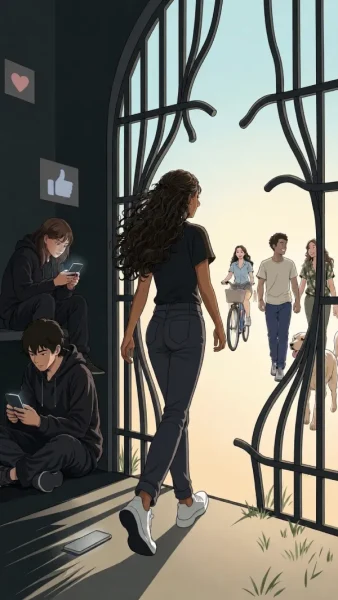
Home » Blog » Social Built A Prison And Gave It A Like Button. Are You Ready To Break Free?
Social Built A Prison And Gave It A Like Button. Are You Ready To Break Free?
Scroll. Tap. Refresh. Repeat.
What feels like connection has quietly become confinement. Big social media platforms didn’t stumble into this—they engineered it. Endless feeds, algorithmic validation, and dopamine spikes have created an environment that’s addictive by design and, for many, damaging to mental health (Ahmmad et al., 2025; De et al., 2025). The result? A generation that’s more “connected” than ever, yet increasingly isolated (Nesbit & Lole, 2025).
So the solution seems obvious: log off.
But then comes the harder question—what now?
If you step away, where do you go to find community, identity, and connection again?
Enter Flocker: A Way Out
Meet Flocker—an app designed to get you on your phone… so you can get off of it.
It doesn’t try to replace real life. It tries to restore it.
Instead of feeding you curated lives and endless distractions, Flocker helps you build something tangible: real-world experiences with real people.
Social media has trained us to believe that our identity and sense of belonging live online—that leaving means losing a part of ourselves (Nesbit & Lole, 2025). Flocker challenges that idea by helping you rediscover those things in the physical world.
Real Connection, Not Just Content
Flocker acts as a bridge—not a destination.
It gives you a simple way to:
Connect with your existing friends
Discover new communities
Turn shared interests into real-life experiences
Think of it as scratching the social itch—but in person.
Immediate, accessible, and human.
What You Can Do With Flocker
Flocker helps you find:
Events tailored to your interests
Genuine community and belonging
Easy ways to coordinate with friends
New hobbies and passions
Activities that get you out of the house and off your screen
Or Better Yet—Create Your Own
Don’t see what you’re looking for? Build it.
With Flocker, you can create your own events:
A board game night at your favorite café
An art showcase at your local park
A last-minute concert meetup
Anything that brings people together
You’re no longer waiting for something to happen—you’re making it happen.
Built for Convenience
Flocker isn’t just about ideas—it helps you execute them.
You can:
Design and organize your event
Handle logistics with ease
Make your event visually appealing
Schedule with friends and attendees
Ensure safety and legitimacy
Avoid bots and fake signups
Every account is verified, so you know you’re interacting with real people—not algorithms.
Designed With Safety in Mind
In a time where digital trust is fragile, Flocker prioritizes your security:
Encrypted messaging
Strong privacy protections
A strict guarantee that your personal data will never be sold or shared
The Exit Door Is Open– Break Free
Social media gave us the illusion of connection while quietly taking something real away.
Flocker offers a way to take it back.
Not by rejecting technology entirely—but by using it differently.
So the question isn’t just whether you’re ready to log off.
It’s whether you’re ready to step back into real life… with Flocker
References
Ahmmad, M., Shahzad, K., Iqbal, A., & Latif, M. (2025). Trap of Social Media Algorithms: A Systematic Review of Research on Filter Bubbles, Echo Chambers, and Their Impact on Youth. Societies, 15(11), 301. https://doi.org/10.3390/soc15110301
De, D., El Jamal, M., Aydemir, E., & Khera, A. (2025). Social media algorithms and teen addiction: Neurophysiological impact and ethical considerations. Cureus, 17(1). https://doi.org/10.7759/cureus.77145
Nesbit, T., & Lole, L. (2026). A Qualitative Investigation of Social Media Fear of Missing Out (FoMO) and Needs Fulfillment Among Young Adults. International Journal of Human–Computer Interaction, 42(7), 5109–5125. https://doi.org/10.1080/10447318.2025.2543998