
Somewhere along the way, we all agreed—quietly, collectively, suspiciously—that “I’ll see you soon” could mean anywhere between 3 days and 3 years.
Welcome to the friendship recession.
Not the kind with stock tickers and CNBC panic. This one is more subtle. It shows up in unresponsive group chats, in a “we should catch up soon” that turns out not to be so soon, and in the strange modern phenomenon of having hundreds of online connections but no one you’d feel comfortable texting “come with me to the ER.”
Researchers have recently been pointing to this shift in how people connect, noting that strong, long-term relationships have lessened and trouble with sustaining significant friendships has increased (Harvard Kennedy School, 2025). In other words: it’s not just you. The entire social ecosystem is quietly suffering.
Or, put differently: everyone has 247 unread messages and somehow nobody knows what they’re doing this Friday night.

We Didn’t Stop Having Friends. We Stopped Doing Friendship.
Here’s the weird part. Most people still believe they have friends. Technically, they do. There are names saved in phones. There are Instagram mutuals. There are “likes” exchanged like diplomatic treaties.
But friendship used to be something you actively participated in, supported, and maintained.
Now it’s more like a background app that occasionally sends a notification like:
“You should hang out with Jake sometime.”
And then Jake becomes a mythological figure you reference in stories but never encounter in the wild.
“My friend Jake…”
My guy– are we sure Jake still exists?
The discussion around what some are calling a “friendship recession” highlights how life today (workload, online communication, misaligned schedules, etc) has made true connection more optional, and therefore more fragile (Harvard Kennedy School, 2025).
Optional is dangerous.
Optional is how gym memberships survive.
Optional is also how group chats called “Summer Plans” make it to October with zero plans.
Part of the Problem: Effort Became Embarrassing
There’s a strange social tax on trying too hard.
Text someone twice? Desperate.
Suggest plans too quickly? Intense.
Follow up after “we should hang”? Criminally invested.
So everyone collectively agrees to chill.
And by “chill,” we mean stare at each other’s Stories for six months without exchanging a single word.
This is how friendships now operate:
- “We should hang!” and both people mean it
- Calendar friction
- *silence*
- Reunion 14 months later at a wedding where you say “we need to do this more often” while fully knowing you won’t
Stop waiting for the event you get an inevitable obligation invite to only to then haul your butt across the country so you can mingle with a bunch of past acquaintances whose names you can barely remember.
Start going to events you actually find interesting with people you actually care about and will speak to in the next month.

Enter: the Flocker Opportunity
But how do you start? This is where Flocker comes in.
At Flocker, we’ve been thinking about a simple but annoying truth: people don’t lack desire for connection— they lack the energy to plan and follow through.
Everyone wants to do things.
Nobody wants to coordinate them.
Planning a hangout now involves:
- 6 schedules
- 3 half-responses
- 1 person who says “I’m down” but disappears into the void
- eventual momentum loss leading to yet another dead group chat
There is always one friend whose contribution is simply “down” and then they vanish like a side character after Episode 2.
So spontaneity dies not from lack of interest, but from logistics.
The friendship recession isn’t really about loneliness in the abstract. It’s about friction. Tiny, but impactful, friction.
The kind that makes you give up and watch some tv show you’ve already seen twice instead of speaking to a human being.
Or worse: spending all day deciding what to do and then accidentally spending the evening watching short-form video content about other people doing things.
Flocker’s premise is basically: what if IRL connection didn’t require a group chat negotiation summit?
What if you could just… show up to something real happening nearby? A pop-up of local artistic vendors, a rooftop pool party, a spontaneous micro-event where “who’s going?” doesn’t require a spreadsheet?
Because friendship doesn’t usually fail at the “care” stage.
It fails at the “coordinate five adults without losing the will to live” stage.
We Are Not Anti-Social. We Are Over-Scheduled
The irony is that people today are not less social.
They’re just socially jammed.
We didn’t stop connecting. We just moved connection into spaces where it feels productive, asynchronous, and easily ignorable.
Friendship doesn’t survive well in environments where it has to compete with calendar invites labeled “optional but important” or emails featuring the modern workplace’s favorite phrase: “circling back.”
Nobody has ever wanted to circle back. Not once.
The Fix Is More Moments, Not More Notifications
The proposed solutions to the friendship recession ultimately point toward something uncomfortable: connection doesn’t scale cleanly.
It has to be practiced, repeatedly, in real time, with actual humans who can leave the conversation.
That’s the part nobody wants to optimize for.
Because it’s messy. It’s unstructured. It doesn’t come with a progress bar. There’s no streak. No achievement badge. No yearly recap telling you that you spent 14,000 minutes maintaining meaningful friendships.
But it also happens to be the only version that actually works.
How Flocker Fixes the Friendship Recession
The friendship recession isn’t happening because people forgot how to be social.
It’s happening because modern friendship has become operationally complex.
Meeting people used to be built into life. You saw the same people at school, work, local events, third places, and random social gatherings. Friendship was often a byproduct of simply existing around other humans.
Now, making a new friend can feel like a project management exercise.
That’s where Flocker comes in.
Instead of asking you to organize everyone, create a group chat, pick a time, find a location, collect RSVPs, send reminders, and pray nobody bails, Flocker will help you discover things that are already happening around you.
The goal isn’t to replace your friends.
It’s to make it dramatically easier to actually spend time with people.
Maybe your friends are busy. Maybe you just moved to a new city. Maybe your group chat has been “figuring something out” for six consecutive weeks.
Instead of spending another Friday night watching the planning phase fail in real time, you can find something happening nearby and go.
The funny thing about friendship is that it usually doesn’t start with “Let’s become friends.”
It starts with “That was fun.”
You see the same people at events. You run into familiar faces. You discover shared interests. Conversations happen naturally because everyone is already there for a reason.
That’s what makes real-world connection different from endlessly scrolling profiles or sending cold DMs.
Flocker will create more opportunities for those moments.
More chances to say yes.
More reasons to leave the house.
More opportunities to turn “we should hang sometime” into an actual memory.
Because the cure for the friendship recession isn’t convincing people to want connection.
Most people already do.
The challenge is making connection easier to find than another night spent scrolling, refreshing the group chat, and waiting for someone else to make a plan.
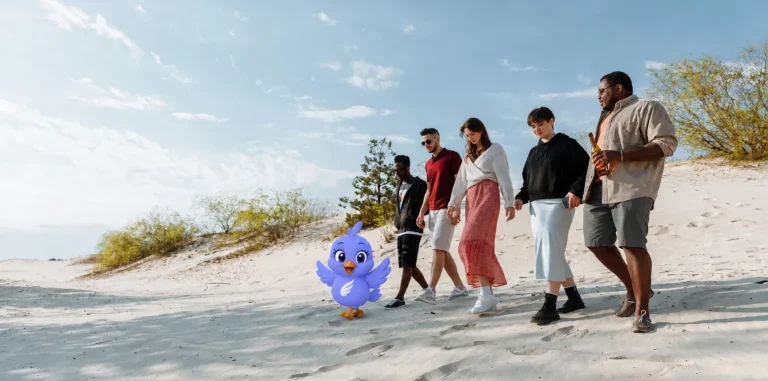
So, What Now?
We could keep pretending we’re “just busy.”
That’s socially acceptable, emotionally convenient, and mostly false.
Sometimes we are busy.
Sometimes we spend two hours deciding what show to start and then end up doomscrolling while the tv plays in the background instead.
Or we can admit the obvious: friendships don’t die because people stop caring.
They die because nobody schedules them into a world that refuses to pause.
The friendship recession isn’t a future threat.
It’s already here, quietly sitting in your “we should catch up soon” texts.
The good news?
Recessions end when behavior changes, not when people suddenly become different humans.
And sometimes all it takes is removing the friction between “I’d go to that” and actually going.
Start actually going, with Flocker.
Find your meet ups, host your events, connect with your people.
Join the waitlist and end your friendship recession.
References
Harvard Kennedy School, Institute of Politics, Center for Public Leadership. (2025, February). The friendship recession: The lost art of connecting. Harvard Happiness Lab. https://www.happiness.hks.harvard.edu/february-2025-issue/the-friendship-recession-the-lost-art-of-connecting